Oppenheimer's opposition to the hydrogen bomb
American PrometheusJ. Robert Oppenheimer's opposition to the hydrogen bomb was at once a moral judgment about mass civilian death and a strategic argument against treating ever-larger weapons as a source of security. In 1949, as chair of the General Advisory Committee, he urged the United States not to build or demonstrate the thermonuclear weapon. He proposed arms control and a more limited military posture instead. The proposal did not mean rejecting nuclear deterrence altogether: Oppenheimer also backed tactical atomic weapons, a position that exposed a tension between resisting genocidal warfare and making nuclear weapons more usable.
The case against the Super
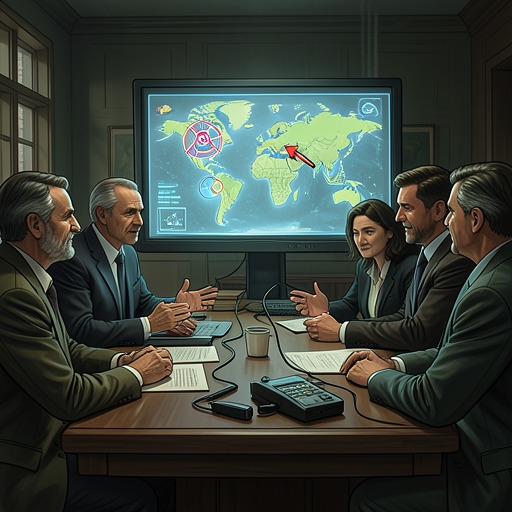
The context for Oppenheimer's position was changing rapidly. In 1949 the United States was not at war, the Soviet Union had successfully tested an atomic bomb, and the General Advisory Committee's members were among the country's most experienced atomic scientists. They believed that a weapon capable of annihilating life could not be assessed as a merely technical or military instrument; moral considerations belonged in the decision.
Oppenheimer feared that the proposed Super would be too destructive to have a legitimate military target. The Hiroshima bomb had an explosive yield of 15,000 tons of TNT; a feasible thermonuclear weapon might yield 100 million tons and devastate 150 to 1,000 square miles or more. In his view, targets suitable for a weapon of that scale would be too small to justify its use. The committee's report warned that “a super bomb might become a weapon of genocide.” Even without being fired, the weapon's presence in the American arsenal could persuade other countries that the United States contemplated an act of annihilation, damaging world opinion and, ultimately, American security.
The committee therefore opposed not only production but also a demonstration of feasibility. Oppenheimer wrote for the majority, “We believe a super bomb should never be produced,” and argued that “Mankind would be far better off not to have a demonstration of the feasibility of such a weapon. . . .” The distinction mattered: a demonstration could validate the weapon and intensify the international consequences even before it entered operational service.
An alternative to an arms race
Oppenheimer's argument addressed the possibility that the Soviet Union might develop a Super first. He and the committee reasoned that an American crash program would not deter the Soviets from pursuing the weapon. A Soviet test would be detectable, and the United States already possessed a large atomic arsenal capable of retaliation. As the report put it, “Should they use the weapon against us, reprisals by our large stock of atomic bombs would be comparably effective to the use of a super.” Refusing to build the weapon, they hoped, might also create room to reopen arms-control negotiations with the Soviet Union.
The committee's proposed alternative was nuclear sufficiency rather than accumulation without a defined military purpose. If a Super was too large to serve as a practical battlefield weapon, the United States could direct resources toward producing fissile material for smaller tactical atomic weapons. Alongside stronger conventional forces in Western Europe, those weapons, the committee argued, could deter a Soviet invasion more credibly and economically than a thermonuclear crash program. The proposal sought to match an arsenal to specific military tasks rather than enlarge it through an open-ended contest.
This alternative grew into a broader challenge to strategic bombing. Oppenheimer was appalled by an Air Force war plan he saw in 1951, which called for the destruction of Soviet cities on a scale he regarded as criminal and genocidal. He later told Freeman Dyson, “That was the goddamnedest thing I ever saw.” In the classified Project Vista report, he helped argue that thermonuclear bombs were unsuitable for tactical battlefield use and that the United States should consider a public no-first-use policy. The report also proposed giving the Strategic Air Command only a third of the country's supply of fissile material, with the remainder allocated to the Army for tactical weapons.
The shift carried a real contradiction. Oppenheimer had argued in 1946 that atomic weapons “are not policy weapons, but . . . are themselves a supreme expression of the concept of total war.” By 1951, he described tactical atomic weapons as support for military campaigns whose primary purpose was victory, rather than as weapons of totality or terror. This reasoning opposed the prospect of deliberately obliterating cities, but it also treated battlefield nuclear use as possible. The account identifies a danger in that position: tactical weapons could act as a nuclear trip-wire, provoking an exchange of increasingly powerful weapons, a scenario Oppenheimer did not address in his effort to counter the Air Force's plans for strategic annihilation.
Committee victory and political cost
The General Advisory Committee's recommendation initially prevailed within the United States Atomic Energy Commission. On November 9, 1949, the commissioners voted three to two to endorse it. David Lilienthal, Pike, and Henry DeWolf Smyth opposed a crash program for the Super; Lewis Strauss and Dean supported one. Oppenheimer was pleased with the deliberations, though his secretary, Katherine Russell, predicted that the report would cause him trouble.
His opposition became part of the political conflict surrounding nuclear strategy. Powerful advocates of massive retaliation were troubled by his challenges to the military's plans and by his continuing willingness to question nuclear policy. In 1953, when Strauss handed Oppenheimer a letter declaring him a security risk and listing thirty-four charges, one charge referred to his strong opposition to developing the hydrogen bomb in 1949 and afterward. A policy argument about the scale, use, and consequences of a weapon had thus become evidence against the scientist who had made it.
Meaning and limits of his position
Oppenheimer's opposition rested on linked claims: that the Super's scale made its use inseparable from civilian destruction; that possessing it could damage American security even if it were never used; and that enlarging the arsenal was not the only way to deter an adversary. His proposal to reject thermonuclear development and seek arms control treated restraint as a possible instrument of security, not simply as an expression of moral disapproval.
Yet his own alternative did not escape the dilemmas he identified. Tactical atomic weapons might offer a more limited military role than city-destroying thermonuclear attacks, but their incorporation into battlefield plans increased the possibility of actual nuclear use and escalation. That tension makes his opposition more than a straightforward rejection of weapons: it was an effort to draw distinctions among kinds of nuclear force and their purposes, while revealing how difficult it was to prevent a strategy intended to limit destruction from opening another path toward it.